
Extended Producer Responsibility (EPR) is quickly reshaping how packaging is regulated, financed, and managed in the United States and around the world. It’s a huge change for manufacturers and packaging companies: you’re responsible not only for putting the packaging out into the world, but also for what happens to it after the consumer is done with it.
What Is Extended Producer Responsibility (EPR)?
EPR is a policy framework that shifts the financial and operational responsibility for packaging waste from consumers and municipalities to the companies that produce it.
Under EPR laws, “producers” typically include:
- Brand owners
- Manufacturers
- Importers
- Distributors or private-label owners, in some cases
The core idea is simple: if you design and profit from the packaging, you should help pay for and support the recycling and waste management systems needed to handle it at the end of its lifecycle.
Where Sunrise Fits in the EPR Cycle
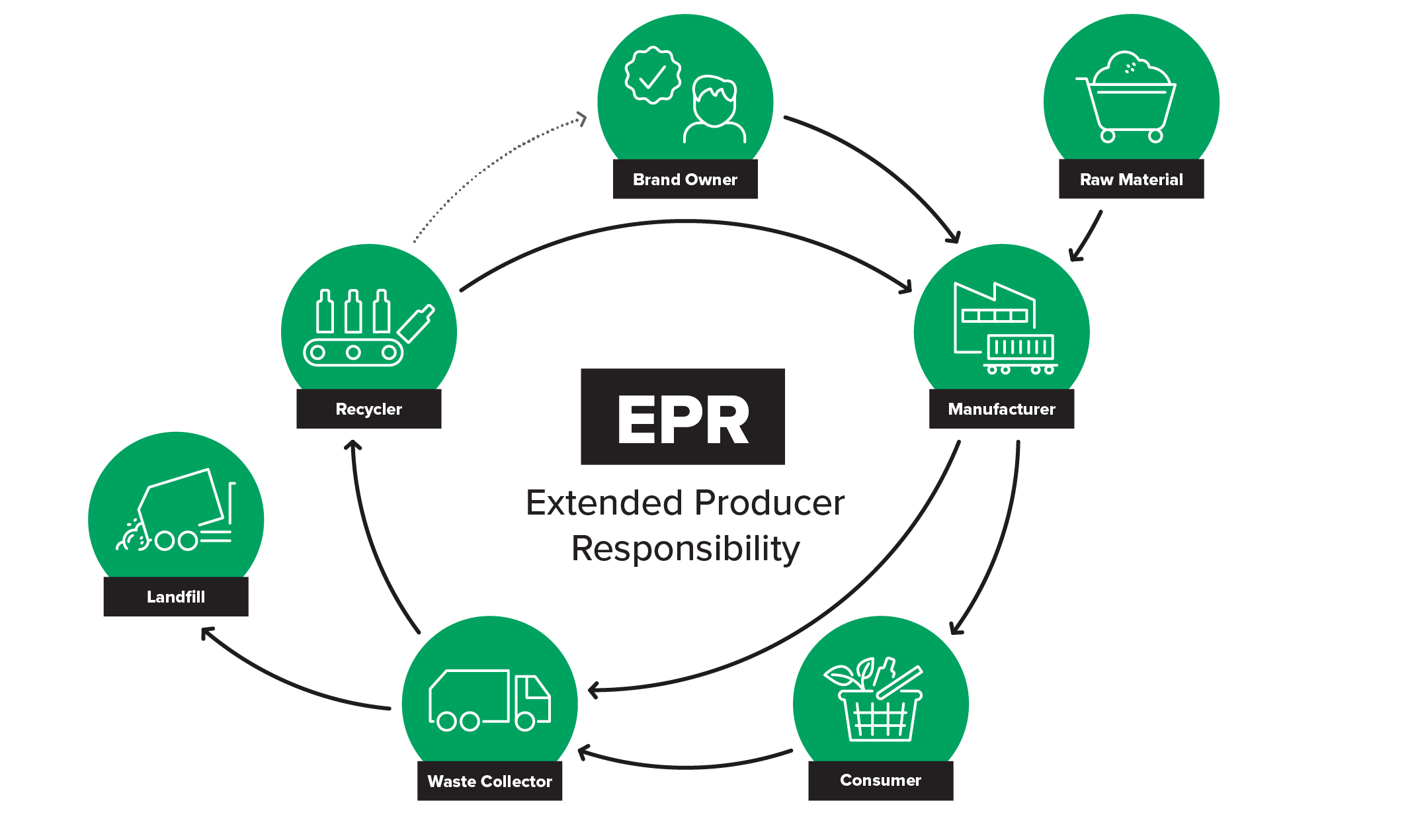
As illustrated in the EPR lifecycle above, material moves through a series of interconnected stages. Sunrise participates in this cycle in several key ways:
- Collection and sorting: We gather and receive post-industrial material and certain post-consumer plastics, sorting them into usable streams for further processing
- Recycling: We process recovered material, helping divert plastics from landfill and return them to productive use
- Manufacturing support: As a compounder, we create specialized resin formulations tailored to client needs, enabling the reuse of recovered material in new applications
This multi-role involvement allows Sunrise to support material recovery and reuse at multiple points in the EPR system, helping close the loop in practical ways.
How EPR Works
While EPR programs vary by state and country, most packaging EPR laws share several common elements:
Producers must:
- Register with a state-approved Producer Responsibility Organization (PRO)
- Report the types and quantities of packaging they place into the market
- Pay fees (often called eco-modulated fees) based on material type, recyclability, and system impacts
- Provide documentation or verification of recycling outcomes and compliance
The money collected from these fees goes toward support recycling, composting, education, infrastructure upgrades, and system improvements at the state or local level.
Why More States Are Adopting EPR
Packaging waste is getting harder and harder for local governments to handle, due to things like:
- Rising volumes of single-use packaging
- Contamination in recycling streams
- Unpredictable recycling markets
- Limited local budgets
EPR offers states a way to:
- Create a stable funding source for recycling programs
- Make the entire system perform better
- Incentivize smarter packaging design from the start
- Reduce the financial burden on taxpayers
As a result, more states are adopting or actively considering EPR laws. This means manufacturers are increasingly likely to face EPR rules in multiple states, not just one.
What EPR Requires From Producers
For manufacturers and packaging companies, EPR introduces new responsibilities that go beyond traditional compliance.
1. Documentation and Proof
You need to track and report packaging data with much greater precision. This usually includes:
- Material types and weights
- Packaging formats
- Volume placed on the market
- Proof that materials are recyclable or properly managed
In some cases, you may be required to provide third-party verification that materials are being recycled through approved systems.
2. Fees and Taxes on Packaging
EPR programs typically require producers to pay fees based on:
- What material you choose
- How easily the packaging can be sorted and recycled
- The use of complex or hard-to-recycle materials
These fees function similarly to a packaging tax, though they are usually administered through PROs rather than traditional tax agencies. Over time, fee structures are designed to incentivize more recyclable and lower-impact packaging.
3. Ongoing Reporting and Compliance
EPR is not a one-time obligation. Producers must:
- Submit regular reports
- Update material data as packaging changes
- Maintain records for audits or regulatory review
This adds a new layer of operational and administrative responsibility, particularly for companies selling into multiple states.
Why Packaging Design Now Matters More Than Ever
EPR policies directly link packaging design decisions to cost and compliance outcomes.
Materials that are widely recyclable, compatible with existing recycling infrastructure, and easy to sort and process are more likely to carry lower fees and fewer compliance risks.
Conversely, packaging that uses mixed materials, lacks viable recycling markets, or creates contamination challenges may face higher fees, additional scrutiny, or future restrictions.
How to Get Ready for EPR
To prepare for these expanding EPR laws, manufacturers and packaging companies should take a few key steps:
- Audit your current packaging materials and formats.
- Improve your internal data tracking and documentation systems.
- Talk to suppliers about material transparency.
- Monitor state-by-state EPR legislation.
- Evaluate how your packaging choices will affect your long-term costs.
The Bottom Line
For manufacturers and packaging companies, understanding EPR now is the first step toward staying compliant, controlling costs, and designing packaging that works in a rapidly changing regulatory environment.
As companies evaluate how to meet emerging EPR requirements, identifying reliable partners for material recovery and reuse is becoming increasingly important. Because Sunrise operates across multiple points in the cycle, we can help producers identify practical paths for managing post-industrial and select post-consumer materials. If you’re evaluating options to support your EPR strategy, get in touch to explore whether there’s a fit.
